-
 [email protected]
-
 +86-17712471297
[email protected]
+86-17712471297

Content
A benchtop UV aging test chamber with a single lamp bank and basic controller typically starts around $3,000–$6,000, while a full-size chamber built to ASTM G154 or ISO 4892-3 with irradiance control, black panel temperature sensors, and programmable condensation cycles runs $8,000–$25,000+. Chambers with dual UVA/UVB lamp banks, PLC-based data logging, and larger specimen racks for continuous industrial testing can exceed $30,000.
Price differences mainly come down to five factors:
Ongoing costs matter as much as the purchase price. UV lamps degrade over roughly 1,600–2,000 hours of use and need periodic replacement, so buyers should factor lamp cost per set (often $150–$400 for a bank of 8) into total cost of ownership rather than judging equipment purely on sticker price.
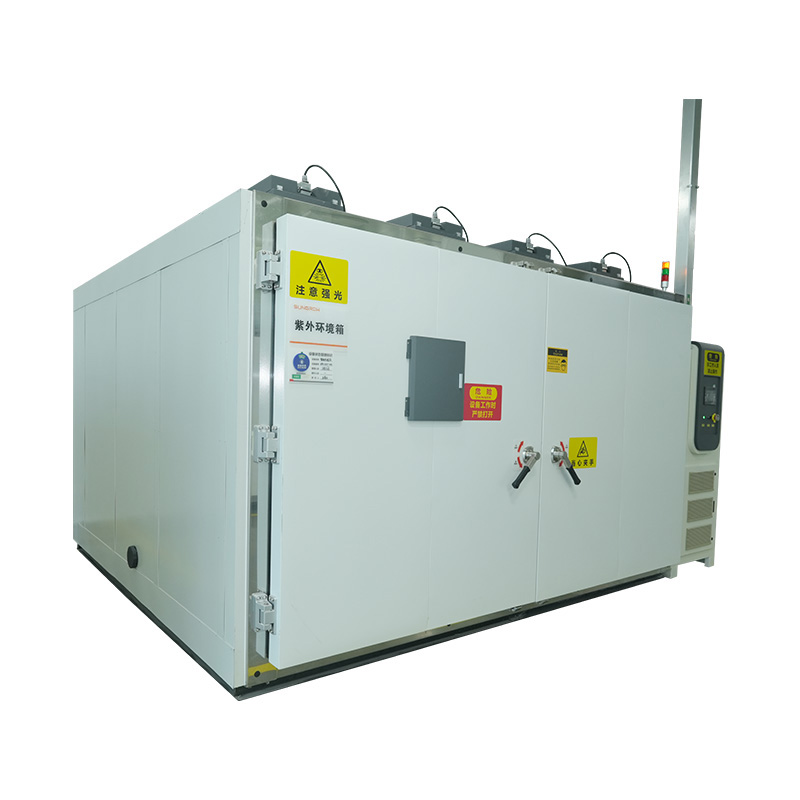
Beyond price, the specification sheet determines whether a chamber will actually produce results that match real-world weathering data. The specifications that matter most are:
| Specification | Typical Range | Why It Matters |
|---|---|---|
| Irradiance level | 0.35–1.55 W/m²/nm | Determines aging speed and comparability to outdoor exposure |
| Black panel temperature | 45°C–70°C | Simulates surface heating from sunlight, critical for polymer degradation rate |
| Lamp type | UVA-340, UVB-313 | UVA-340 best matches solar UV spectrum for outdoor durability testing; UVB-313 accelerates faster but with a less realistic spectrum |
| Temperature uniformity | ±2°C | Poor uniformity across the specimen rack causes inconsistent aging between samples |
| Humidity/condensation control | 50°C condensation, 8h cycle | Required for full ASTM G154 compliance testing that includes moisture cycling |
| Specimen capacity | 8–24 panels | Affects batch testing throughput for production QC programs |
Chambers referencing ASTM G154, ASTM D4329, ISO 4892-3, or SAE J2020 in their datasheet are built to recognized accelerated weathering standards, which matters when test reports need to be accepted by customers, regulators, or certification bodies.
"UV weathering chamber" and "QUV tester" are often used interchangeably in the industry, since QUV is a well-known trade name for fluorescent UV weathering equipment following ASTM G154. Fluorescent UV chambers differ from xenon arc weathering testers in a few practical ways:
For most plastics, rubber, coatings, and paint durability screening, a fluorescent UV chamber gives a faster, more cost-effective correlation to outdoor UV degradation than a xenon arc unit.
Test parameters should be tuned to the material being evaluated rather than run at a single default setting:
Polymer compounds such as PP, PE, and PVC are typically tested under UVA-340 lamps at a black panel temperature around 60°C to evaluate chalking, embrittlement, and color shift. Cycle times of 500–1,000 hours are common for screening formulation changes before full outdoor exposure testing.
Rubber and elastomer seals are more sensitive to combined UV and ozone exposure, so chambers with condensation cycling help simulate the cracking and surface hardening seen in outdoor gaskets and weatherstripping. Lower black panel temperatures (45–50°C) are sometimes used to avoid over-accelerating thermal effects that don't occur outdoors.
Architectural and automotive coatings are usually tested per ASTM D4587 or ISO 11507, alternating UV exposure with condensation to reproduce dew-cycle degradation. Gloss retention, color change (Delta E), and adhesion loss are the main measurements taken at set intervals throughout the test.
Before ordering, it helps to confirm a few operational details that don't always show up on a spec sheet:
Chambers used for internal R&D screening can tolerate simpler controllers and lower calibration frequency, while chambers producing test reports for customers or certification bodies should prioritize calibration traceability and repeatable irradiance control above other features.

We value your suggestions and questions. If you have any questions about our products and services, please contact us. We will treat you responsibly and reply to your information as soon as possible.
 Building 14, Chuangjin Industrial Park, Zhitang Town, Changshu City, Suzhou City, Jiangsu, China
 +86-17712471297


 EN
EN
 English
 中文简体
中文简体